Architectural Features
< back
sort items by:
page  1  of  10
per page: 
SOLD
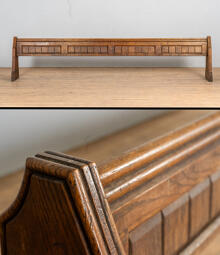
40095 Rare 19th Century oak pew seats
QTY: SOLD £125 Per Run Metre
40094 19th Century oak panelling on feet
QTY: 1 £400
40093 19th Century narrow oak panelling
QTY: See Description £100 Per Run Metre
Reserved until 31/10/2026
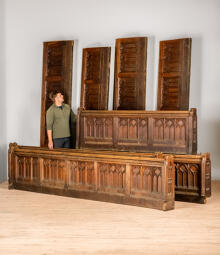
40092 Good run of 19th Century Gothic oak panelling
QTY: 26 M £9,250 Job Lot
40055 Reclaimed wrought iron panels
QTY: 2 £195 Each
40029 Reclaimed hardwood panels
QTY: 2 £300 Each
40007 19th Century finely carved wooden panel
QTY: 1 £245
SOLD
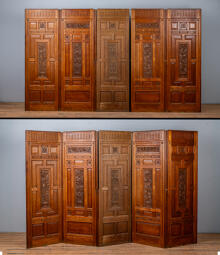
39948 Ornate Victorian oak screen panels
QTY: SOLD £1,750 The Set
39938 Massive reclaimed louvred doors or shutters
QTY: Job Lot £1,395 Job Lot
39725 Oak floor or wall panels circa 1900
QTY: 29 Remaining £265 Each
39618 Run of oak panelling circa 1800
QTY: 5 Run Metre £725 Job Lot
SOLD
39594 An Irish pitch pine panelled bar divider
QTY: SOLD £865
Reserved until 21/10/2026
39571 Antique oak linenfold door panel
QTY: 1 £725
SOLD
39540 Reclaimed oak dado panelling
QTY: SOLD £1,250 Job Lot
39507 Reclaimed louvred teak panel
QTY: 1 £565
39506 Reclaimed louvred teak panel
QTY: 1 £565
39505 Large reclaimed teak lattice panel
QTY: 1 £495
39503 Large reclaimed teak lattice panel
QTY: 1 £495
39502 A large reclaimed teak lattice panel
QTY: 1 £495
39423 Antique Bastar panel on a frame
QTY: 1 £845
39187 Reclaimed Gothic oak tracery headers
QTY: 4 Sections £175 Each
SOLD
39185 A Gothic oak panel ex York Minster
QTY: SOLD £145
SOLD
39184 A section of oak Gothic panelling
QTY: SOLD £525
SOLD
39183 Rare run of Gothic oak panels ex York Minster
QTY: SOLD £795 Job Lot
page  1  of  10
per page: 

Panelling and Screens


Wood panelling first started to appear around the 15th Century.  At this time it was known as wainscotting, and the wood panels, primarily of oak, served to make the interior of old stone buildings more comfortable, providing insulation and decoration to otherwise stark stone walls. Early panelling is invariably made of oak, but in the 17th and 18th centuries, deal and pine were also commonly used. The panelling was often painted or limewashed, the cheaper softwoods were also sometimes given a painted woodgrain finish to resemble more expensive oak.  Early panelling typically incorporated sections of carved wood, especially linenfold patterns and geometric shapes, often diamond in form. 

Some of the most beautiful panelling comes from France, 17th and 18th Centuries, known as Boiserie.  This panelling is usually very elegant and is often painted and gilded. 

Wood panelling has continued to be popular into the 20th Century, the Edwardians were very fond of having panelled billiards rooms and studies. English Salvage usually has a good selection of reclaimed panelling in oak, mahogany and softwoods, both British and Continental.  Wood panelling is especially popular with designers for shop fittings, restaurants and bars, to create a traditional ambience, or to clad bar fronts or create dividers.  Glazed screens, mostly 19th and 18th Century, are also used to create dividers in shops and bars, where transmission of light is important, these often incorporate sections of stained glass. 

Are you sure you want to empty your bookmarks? This cannot be undone.

NEWSLETTER SIGN UP
© 2014 - 2026 English Salvage Ltd       Website by ph9